09/12/2025
Session ”End of life, start of supply: Advancing battery recycling in Europe”
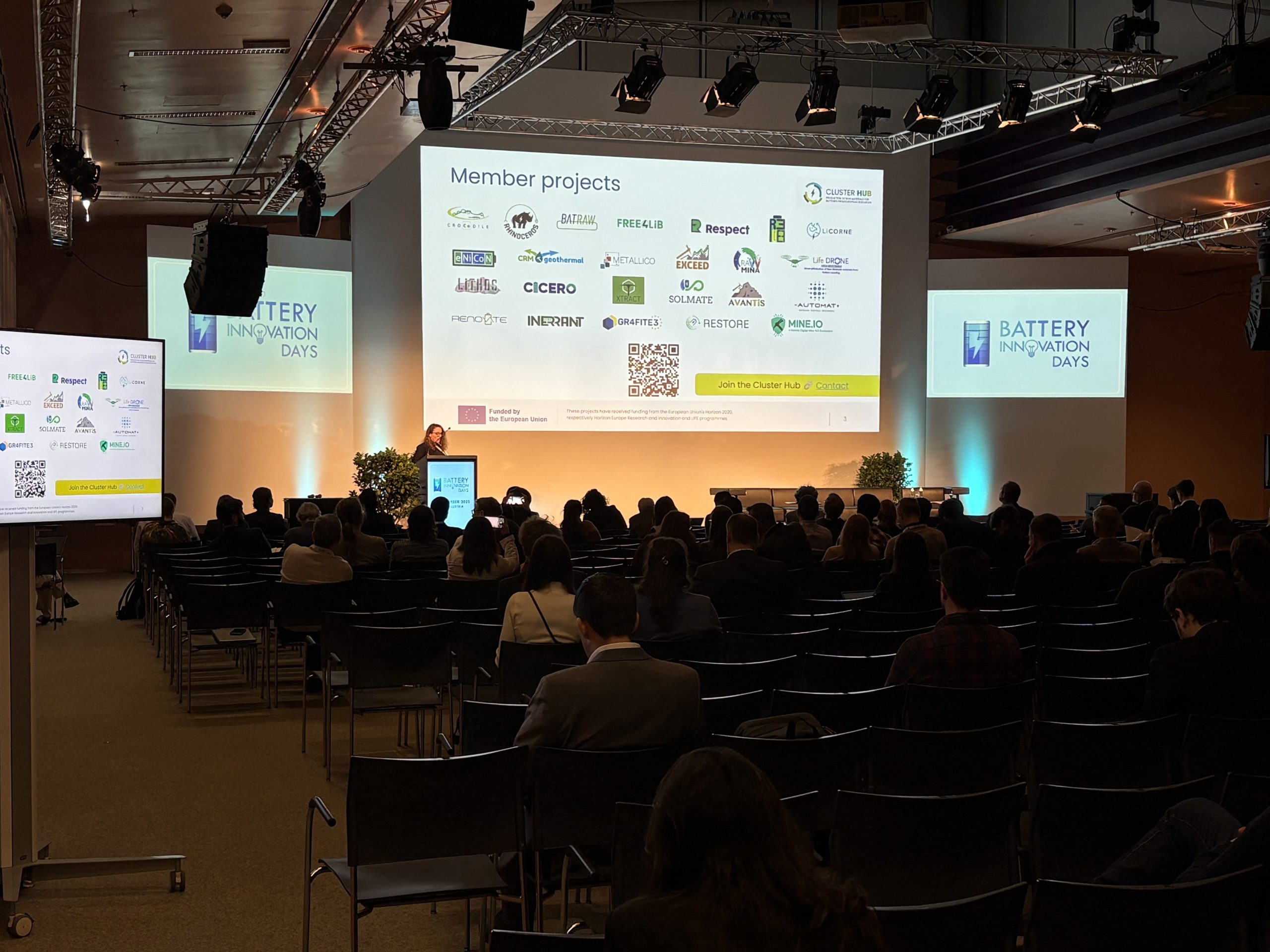
The Cluster Hub “Materials for Batteries” took the stage at Battery Innovation Days 2025, contributing to the discussion about the strategic role of recycling in the EU Battery Regulation and the broader circular economy.
Presentations explained, one after the other, Europe’s alternatives to build a circular battery ecosystem. With electric mobility accelerating and battery demand soaring, recycling is no longer optional. It has become a strategic necessity for Europe’s competitiveness and climate goals. And the EU wasted no time to announce on 3 December its recent ReSourceEU Action Plan, under the headline “Accelerating our critical raw materials strategy to adapt to a new reality”. ReSourceEU places circularity at the core of EU’s approach to set the basis for competitive CRMs industry in Europe.
Eleonora Cali (RINA), representing the Materials for Batteries Cluster Hub in the parallel session “End of life, start of supply: Advancing battery recycling in Europe” on 2 December, joined leading experts to address two pressing realities in the battery industry:
- Europe’s dependency on imported raw materials. Lithium, cobalt, nickel, manganese and graphite are critical for the energy transition, yet supply chains remain dominated by non-European players. Recycling offers a way to keep these resources in Europe, reduce environmental impact, and comply with EU regulations on secondary raw material content. The European Commission’s new Battery Regulation aims to change that by mandating minimum recycled content for key materials from 2031. This is more than an environmental measure: it is an industrial policy designed to keep resources within Europe and reduce strategic dependency.
- the expected surge of end-of-life batteries. With EU speeding up its transition to electric mobility, the question of what happens to millions of batteries at the end of their lifetime is shifting from technical to strategic priority.
Surprisingly, speakers underlined EU’s anticipated timeline to develop recycling plants, with a scarce input of end of life applications. According to Andreas Opelt (Saubermacher) and Verena Fuchs (Cylib), for electric vehicle batteries, the timeline for returns is uncertain; early fleets are lasting longer than expected, delaying the recycling ramp-up. Opelt concluded his presentation with a pragmatic message: “The storm of batteries is coming, but if you build capacity too early, plants will sit empty”, arguing timing is critical.
Across the EU, roughly 300,000 tonnes of batteries enter the market annually. Collection rates for household batteries account for approximately 50%. Many still end up in mixed waste streams or embedded in consumer products. Lithium-ion batteries, now almost omnipresent in common electronics, pose fire hazards during transport and processing.
Industry response
Saubermacher announced the opening of what Andreas Opel called “Europe’s most modern recycling plant” early next year. The facility will process 50,000 tonnes of batteries annually, using AI-driven sorting to achieve 99% accuracy and advanced fire protection systems.
Cylib, represented by Verena Fuchs, is scaling up its proprietary water-based recycling process, which recovers lithium and graphite with 90% efficiency and an 80% lower carbon footprint compared to conventional methods. After validating its technology through more than 35 industrial projects, the company is preparing its first large-scale plant in Germany, capable of processing feedstock equivalent to 140,000 EV batteries per year. Cylib’s approach reduces chemical use, recirculates water and produces high-purity raw materials, aiming to meet EU targets on recycled content.
“If you don’t get 99% quality in sorting, you will never get raw material purity for reuse,” Opel said, underlining the technical complexity of the task – a challenge numerous members of the Cluster Hub are currently addressing.
EU-funded R&I , collaboration and strategy
Eleonora Cali (Rina Consulting), speaking for the Materials for Batteries Hub underlined that circularity cannot be achieved in isolation – a central idea that generated the hub in the first place. Twenty minutes proved to be a challenge to deliver a presentation of each of the 24 members of the hub. The platform connects projects working on different cross-sectorial aspects of the battery value chain, from battery passports, automated dismantling, to reverse logistics and material recovery. Eleonora brought concrete examples how EU-funded projects like BATRAW, FREE4LIB, CICERO, RENOVATE, RESPECT and GR4FITE3 address these aspects hands-on.
The other cluster, titled Circular Battery, presented by Jefferson Palas (EURECAT), introduced other EU-funded initiatives: BatteReverse, RECIRCULATE, REBELION and REINFORCE, each addressing Europe’s end-of-life battery challenge. Similar to the Materials for batteries Hub, Circular Battery focuses on similar topics: standardising dismantling processes, improving safety during handling and transport, and creating digital tools like battery passports for traceability. Key innovations include automated dismantling, second-life models and protocols to reduce fire risks.
Speakers called for:
- accelerated permitting for recycling infrastructures. In China, you can build a recycling plant in six months. In Europe, six months is not even enough to submit a permit,” Opel warned.
- enforcement of design-for-recycling standards in new battery regulations.
- support for industrial scale-up through funding but also simplified regulation.
- call to impose all possible measures to prevent black mass from exiting Europe, already reinforced by its recent classification as hazardous waste.
Probably one of the messages we take with us and integrate it to our initiatives’ objectives is that policies like the EU’s Critical Raw Materials Act, Battery Regulation and now recently adopted ReSourceEU provide the framework. What is needed now is execution at speed.
 SHARE ON
 Website managed by PNO Innovation