10/06/2026
Europe’s next battery challenge moves beyond recycling
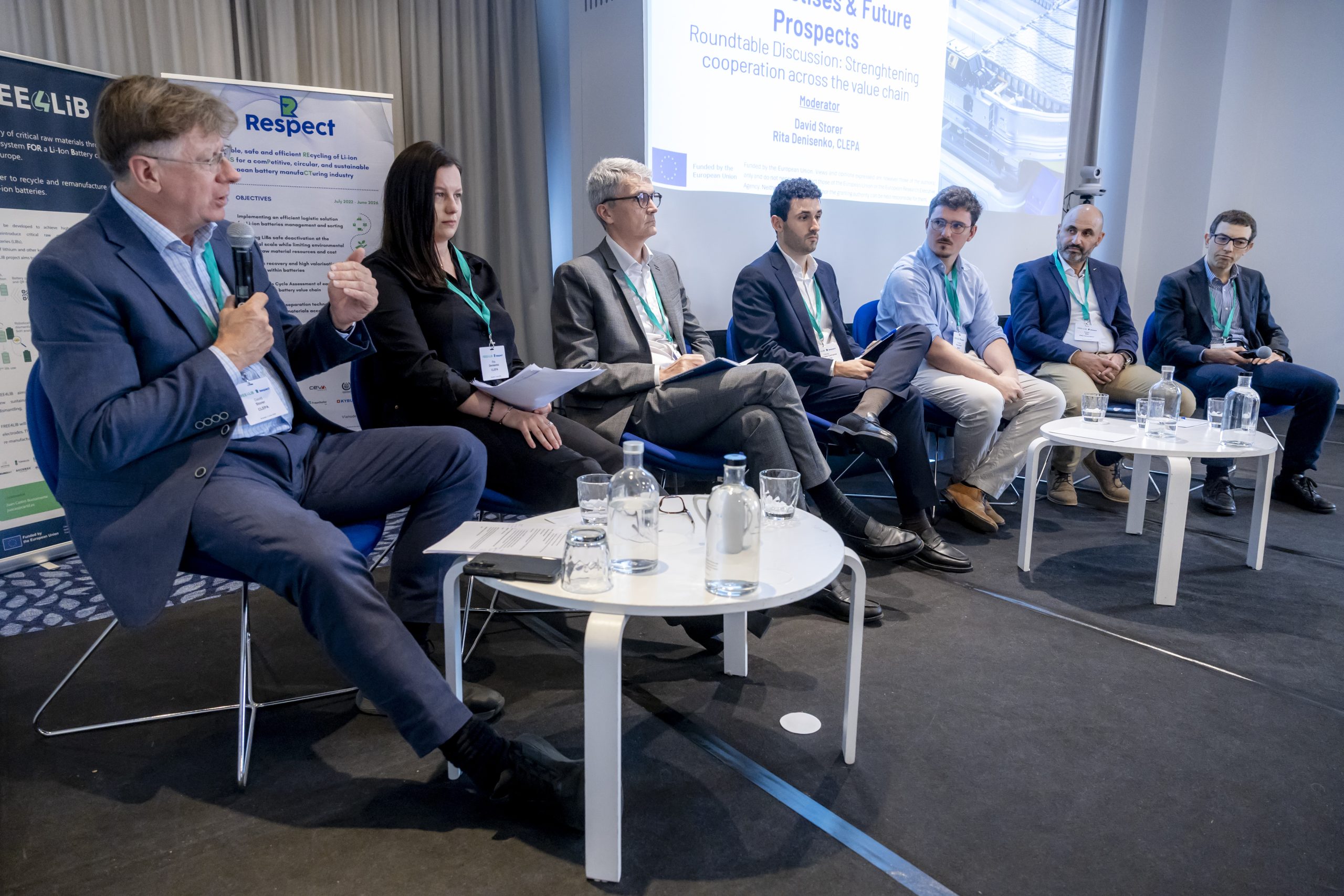
The closing conference RESPECT and FREE4LIB – both part of the Cluster Hub “Materials for Batteries” – did not revolve around scientific results alone. It elaborated on battery circularity now being a part of EU’s industrial policy, supply security and its attempt to secure manufacturing capacity in a more uncertain global market.
While project partners presented their work separately, the panel discussions pointed to a shared concern: policy and industrial reality are not moving at the same pace. If Europe wants materials to circulate within its borders and to secure long-term investment, regulation needs to reflect how the sector actually operates.
1. Circularity has moved beyond engineering, recycling is no longer framed only as an environmental obligation. The EU Batteries Regulation, the Critical Raw Materials Act and the Net-Zero Industry Act have turned circularity into a question of competitiveness, traceability and supply security.
- These policies set the direction for the entire battery life cycle: carbon footprint, recycled content, due diligence, labelling, as well as end-of-life [EoL] obligations.
- The Battery Passport is now integrated part of the same framework, with a general agreement across the panels speakers, on its purpose: recyclers and second-life operators need data on chemistry, state of health and battery architecture to operate safely and efficiently. Its usability remains limited by its capacity to stay ‘workable’.
- The concern lies in how this data is managed. Companies raised questions about ownership, confidentiality, intellectual property and cost of collecting and maintaining the data.
A practical approach emerged during the discussions. Data should be shared on a need-to-know basis. Not every actor requires full access, but the right information must reach the right user in a format they can apply. The passport is also not limited to recycling. It has a role in repair, diagnostics, repurposing and safety management throughout the battery’s life.
2. Clear political intent, but practical hurdles when projects move towards deployment. The investment case is not always there.
The EU framework is starting to influence demand. Europe wants more low-carbon production, more strategic manufacturing capacity and more value retained within its industrial base. The direction may become even more explicit with discussions around a possible Industrial Accelerator Act and “Made in Europe” requirements.
Demand for secondary materials is growing, but not always fast enough to justify the investments required. Speakers kept pointing at the importance of finding ways to reintegrate recycled materials back into manufacturing at scale.
Without enabling elements, capacity risks sitting idle:
- viable business cases
- stable regulation
- system where batteries can move safely across borders
These are also some of the conclusions of the upcoming whitepaper, which will bring together findings from EU-funded projects from the “Materials for Batteries Hub” and reflect on the conditions needed for scale-up, industrial uptake and more resilient European value chains.
Projects such as RESPECT, FREE4LIB, BATRAW, RHINOCEROS and LiCORNE show that technical routes exist, from pre-treatment and direct recycling to lithium recovery and material reintegration. The gap appears when those routes meet permitting delays, financing constraints, uneven market demand, uncertainty over feedstock.
3. Design choices are (still) making recycling difficult.
Discussions around dismantling brought a more practical tension into focus. Batteries are still designed primarily for performance, cost and weight reduction. This leads to welded structures, compact architectures and adhesives that are difficult to disassemble. Under these conditions, end-of-life treatment becomes slower, more complex and more expensive.
At a broader level, we understand that circularity cannot be addressed only at the recycling stage. It needs to be considered earlier, when design choices are still flexible.
4. Standardisation has its own limitations.
Standardisation can support automation in high-volume segments such as electric vehicles, where predictable formats make processing easier.
Outside these segments, especially in industrial applications, one standard does not fit all. Representatives of SAFT pointed to the need to keep design flexibility to match specific uses and operating conditions.
The discussion pointed towards selective standardisation. Common approaches to data, interfaces and safety information can help where they bring value, while leaving room for variation in design where needed. This position was echoed by speakers from BEPA, BMW, EURECAT and ACCUREC.
5. All conclusions lead to “upscaling” and reshaping R&I priorities in the next funding programmes.
Research projects can demonstrate processes such as direct recycling or lithium recovery. The difficulty begins when these processes have to run at industrial level. Several constraints were repeatedly mentioned:
- limited access to consistent feedstock
- long permitting timelines
- high upfront costs
- weak demand for secondary materials
- shortages of skilled labour
Production scrap was identified as a short-term opportunity. Unlike end-of-life batteries, which will arrive in larger volumes later, scrap is already available. It offers a way to build experience and material flows in the near term.
Project timelines also came under scrutiny. Recovered materials often become available late, which leaves little time to test them in new cells and validate performance. This is a concrete lesson for future programme design.
Low-value chemistries such as LFP add another layer of complexity. With fewer high-value metals, recycling becomes less attractive economically, even though safe and compliant treatment remains necessary.
The RESPECT and FREE4LIB conference reflected a sector that is more realistic about its constraints. At the same time, several questions remain open: how to connect recycling with manufacturing, how to make recovered materials viable for industry, how to share data without exposing sensitive information, and how to support deployment without adding further complexity.
In the coming months, the Materials for Batteries Hub will continue to translate project experience into reports and policy input on circularity and battery materials. The aim is to move beyond description and focus on what the sector needs to move forward.
article drafted by PNO Innovation
© photo CLERENS
 SHARE ON
 Website managed by PNO Innovation