The battery panel at EUSEW focused on a question the sector already knows well: how to strengthen Europe’s battery value chain. The discussion brought together perspectives from research, industry and policy, including including contributions from DG GROW, BEPA, ACC, BMW, VUB and IAV. The debate pointed at a conclusion already heard in other EU-level discussions: technology is in place, but production at scale is still a barrier.
Demand is rising quickly, not only from electric vehicles. Stationary storage is expanding, driven by grid requirements and policy incentives. New applications in defence, aviation, robotics and data centres are also entering the market. Each use case requires different battery types, which adds pressure on manufacturers.
This growth comes at a time when Europe is still exposed in three areas: access to raw materials, dependence on third countries and cost.
Policy: shifting from research to production. New Battery Booster Facility is established
Recent policy measures suggest a shift in focus. The €1.5 billion Battery Booster Facility is designed to support projects moving from pilot phase to industrial production, where risks and costs are highest.
At the same time, the discussion is moving towards demand-side measures. Proposals linked to “Made in Europe” aim to create a more predictable market. Without stable demand, investments in materials and components remain difficult to justify.
Three pressure points framed the debate:
- limited access to raw materials
- long development cycles for new technologies
- uncertain demand in end-use markets
Profitability varies across the value chain. Raw and advanced materials can reach margins of 20 to 40 percent, while cell manufacturing remains closer to 5 to 10 percent. This gap shapes investment decisions and influences where support is most needed.
Industry faces high costs and a steep learning curve
From an industry perspective, production is already underway, but at a high cost. Building and operating battery plants requires investments in the order of billions of euros, alongside complex operations that European companies are still learning to manage at scale.
Cost competitiveness remains the core issue. Around 70-75% of battery costs come from raw materials. Manufacturing adds another significant share, with labour, energy and operating costs generally higher in Europe.
During the ramp-up phase, companies operate at a loss while building experience and stabilising processes. The Battery Booster Facility targets this stage, but it does not address all cost differences. Additional support may be needed in the first years after ramp-up, when European products struggle to match global prices.
There is also a clear limit to localisation. A large share of value creation in the automotive sector still takes place outside Europe. Full regional independence is not realistic in the short term. The focus is instead on strengthening European capacity while maintaining global supply links.
Across the panel, there was agreement on one point: customers will not pay a premium simply because a battery is produced in Europe. Cost parity remains a condition for wider adoption.
Research-industrial scale: an uneven link
Europe’s research and innovation base remains solid, with established collaboration between research centres, companies and EU-funded projects. VUB pointed to the need to match battery chemistries to specific applications instead of relying on a single dominant approach. This reflects the variety of use cases, from mobility to stationary storage. At the same time, IAV drew attention to areas that receive less visibility but are becoming central.
Battery management systems, electronics and data handling are increasingly part of the battery architecture. Work on monitoring and predictive maintenance shows how digital functions are being built into battery systems.
The issue is not the absence of knowledge, but the transition from laboratory results to production lines. This step remains inconsistent across projects.
Short summary of all discussion points:
Several conclusions came up repeatedly across the panel:
- Production needs to scale faster to build industrial experience
- The cost gap must be addressed in the early years of operation
- The full value chain, from raw materials to recycling, needs to remain active in Europe
- Demand for European-made products needs to be secured
The Battery Booster Facility responds to part of the challenge by supporting production at a sensitive stage. The next test is whether this is followed by consistent demand and coordination across the value chain. Without these elements, the pattern is likely to repeat itself: strong research capacity in Europe, with industrial production developing elsewhere.
Article drafted by PNO Innovation
The closing conference RESPECT and FREE4LIB – both part of the Cluster Hub “Materials for Batteries” – did not revolve around scientific results alone. It elaborated on battery circularity now being a part of EU’s industrial policy, supply security and its attempt to secure manufacturing capacity in a more uncertain global market.
While project partners presented their work separately, the panel discussions pointed to a shared concern: policy and industrial reality are not moving at the same pace. If Europe wants materials to circulate within its borders and to secure long-term investment, regulation needs to reflect how the sector actually operates.
1. Circularity has moved beyond engineering, recycling is no longer framed only as an environmental obligation. The EU Batteries Regulation, the Critical Raw Materials Act and the Net-Zero Industry Act have turned circularity into a question of competitiveness, traceability and supply security.
- These policies set the direction for the entire battery life cycle: carbon footprint, recycled content, due diligence, labelling, as well as end-of-life [EoL] obligations.
- The Battery Passport is now integrated part of the same framework, with a general agreement across the panels speakers, on its purpose: recyclers and second-life operators need data on chemistry, state of health and battery architecture to operate safely and efficiently. Its usability remains limited by its capacity to stay ‘workable’.
- The concern lies in how this data is managed. Companies raised questions about ownership, confidentiality, intellectual property and cost of collecting and maintaining the data.
A practical approach emerged during the discussions. Data should be shared on a need-to-know basis. Not every actor requires full access, but the right information must reach the right user in a format they can apply. The passport is also not limited to recycling. It has a role in repair, diagnostics, repurposing and safety management throughout the battery’s life.
2. Clear political intent, but practical hurdles when projects move towards deployment. The investment case is not always there.
The EU framework is starting to influence demand. Europe wants more low-carbon production, more strategic manufacturing capacity and more value retained within its industrial base. The direction may become even more explicit with discussions around a possible Industrial Accelerator Act and “Made in Europe” requirements.
Demand for secondary materials is growing, but not always fast enough to justify the investments required. Speakers kept pointing at the importance of finding ways to reintegrate recycled materials back into manufacturing at scale.
Without enabling elements, capacity risks sitting idle:
- viable business cases
- stable regulation
- system where batteries can move safely across borders
These are also some of the conclusions of the upcoming whitepaper, which will bring together findings from EU-funded projects from the “Materials for Batteries Hub” and reflect on the conditions needed for scale-up, industrial uptake and more resilient European value chains.
Projects such as RESPECT, FREE4LIB, BATRAW, RHINOCEROS and LiCORNE show that technical routes exist, from pre-treatment and direct recycling to lithium recovery and material reintegration. The gap appears when those routes meet permitting delays, financing constraints, uneven market demand, uncertainty over feedstock.
3. Design choices are (still) making recycling difficult.
Discussions around dismantling brought a more practical tension into focus. Batteries are still designed primarily for performance, cost and weight reduction. This leads to welded structures, compact architectures and adhesives that are difficult to disassemble. Under these conditions, end-of-life treatment becomes slower, more complex and more expensive.
At a broader level, we understand that circularity cannot be addressed only at the recycling stage. It needs to be considered earlier, when design choices are still flexible.
4. Standardisation has its own limitations.
Standardisation can support automation in high-volume segments such as electric vehicles, where predictable formats make processing easier.
Outside these segments, especially in industrial applications, one standard does not fit all. Representatives of SAFT pointed to the need to keep design flexibility to match specific uses and operating conditions.
The discussion pointed towards selective standardisation. Common approaches to data, interfaces and safety information can help where they bring value, while leaving room for variation in design where needed. This position was echoed by speakers from BEPA, BMW, EURECAT and ACCUREC.
5. All conclusions lead to “upscaling” and reshaping R&I priorities in the next funding programmes.
Research projects can demonstrate processes such as direct recycling or lithium recovery. The difficulty begins when these processes have to run at industrial level. Several constraints were repeatedly mentioned:
- limited access to consistent feedstock
- long permitting timelines
- high upfront costs
- weak demand for secondary materials
- shortages of skilled labour
Production scrap was identified as a short-term opportunity. Unlike end-of-life batteries, which will arrive in larger volumes later, scrap is already available. It offers a way to build experience and material flows in the near term.
Project timelines also came under scrutiny. Recovered materials often become available late, which leaves little time to test them in new cells and validate performance. This is a concrete lesson for future programme design.
Low-value chemistries such as LFP add another layer of complexity. With fewer high-value metals, recycling becomes less attractive economically, even though safe and compliant treatment remains necessary.
The RESPECT and FREE4LIB conference reflected a sector that is more realistic about its constraints. At the same time, several questions remain open: how to connect recycling with manufacturing, how to make recovered materials viable for industry, how to share data without exposing sensitive information, and how to support deployment without adding further complexity.
In the coming months, the Materials for Batteries Hub will continue to translate project experience into reports and policy input on circularity and battery materials. The aim is to move beyond description and focus on what the sector needs to move forward.
article drafted by PNO Innovation
© photo CLERENS
On the 5th of May 2026, the RENOVATE project held its Clustering Workshop: “Circular batteries: Pathways for an integrated value chain in Europe” in Milan. Organised by LOMARTOV, D&C leaders, together with INSTM, the project coordinator, and hosted by AFIL at Innovhub SSI facilities. The workshop welcomed 58 participants onsite and 26 online: experts, policymakers, researchers, and industry stakeholders to learn and discuss the European battery value chain, with a strong focus on circularity, sustainability, and EU regulation.
EU policy perspectives and regulatory developments on batteries
The first session was moderated by Eliana Quartarone, our project coordinator, which featured three keynote speeches from: Martina Orefice, Scientific Policy Support for Critical Raw Materials, Joint Research Centre (JRC); Joan Gonzalez Fabra, R&I Policy Officer from Batteries European Partnership Association (BEPA), and Margherita Moreno, Permanent Researcher ENEA, SET Plan IWG Batteries co-chair. The speakers provided valuable insights into the EU Batteries regulation, current state of play, and how regulatory frameworks are shaping the future of battery research, innovation, sustainability, and circularity across Europe.
Showcasing innovation across EU battery projects
The spotlight then moved to EU large-scale battery clustering initiatives in which RENOVATE is actively involved, including Battery 2030+ and the Cluster Hub. Further details on these initiatives are available in our Clustering section. During this session, 8 projects showcased their innovations and objectives towards battery circularity: AUTOMAT, CICERO, CIRCUBATT, GR4FITE3, RESPECT, RENOVATE, RHINOCEROS, and BATMASS, the latter also addressing broader aspects of the battery value chain.
Additionally, we encouraged you to contribute to four ongoing Cluster Hub surveys, designed to support policy development and skills in the battery sector:
The RELiEF project (Horizon Europe GA 101069789), one of the most mature EU-funded projects in the Cluster Hub “Production of raw materials for batteries from European resources”, has published an open-access study evaluating the coherence of recent EU policies shaping the battery value chain.
The study focuses on the EU’s Green Deal Industrial Plan and related legislative pillars, such as:
- the Net-Zero Industry Act: aims for 40% of clean tech needs to be met by EU production by 2030.
- the Critical Raw Materials Act: seeks to secure EU’s supply of critical raw materials (lithium, cobalt).
- the EU Battery Regulation 2023: introduces strict lifecycle rules to promote circularity and sustainability.
Partners from RELiEF project engaged in discussions with various stakeholders across the battery value chain in Europe to understand the sentiment and the level of perception of these regulations. Their methodology circled around two main questions:
- Do these initiatives complement or contradict each other?
- How do stakeholders perceive these regulations and their feasibility?
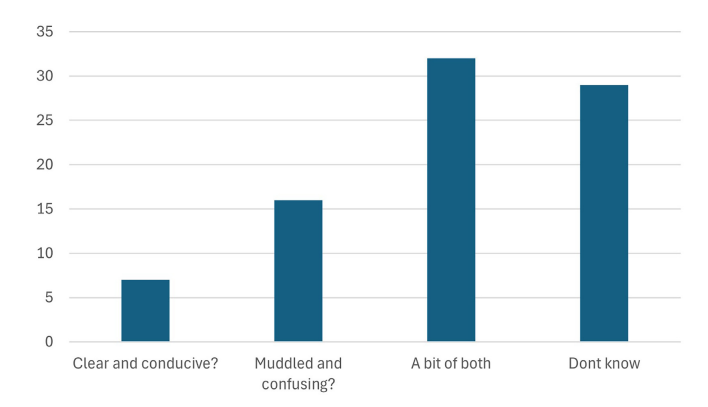
Perception of the EU regulatory climate. ©Research article “Stakeholder Perspectives on EU Regulatory Frameworks: Navigating Critical Raw Materials, Battery Innovation and Recycling Challenges” [web: https://open-research-europe.ec.europa.eu/articles/5-104]
These interactions allowed stakeholders to express additional concerns about skills shortages and social acceptance. Cutting red tape and streamlined permitting remain road blockers for projects both in mining and recycling. Targets such as the NZIA’s 40 % clean tech production and CRMA’s 10 % domestic sourcing were seen as ambitious, while others, like the 15 % recycling goal, were considered feasible and relaxed. The call for more balanced policy objectives and realistic targets was a recurring topic.
The Cluster Hub’s annual workshops and bilateral meetings between projects created opportunities for the ReLIEF partners to engage with a variety of stakeholders in the battery sector. It facilitated collaboration and discussions between EU-funded projects, revealing a shared sentiment about the EU regulatory ecosystem and common barriers that risk slowing EU’s industrial competitiveness.
On 12 December 2024, the third edition of the annual workshop of the Cluster Hub “Production of Raw Materials for Batteries from European Resources” took place in Brussels, being co-organised by EU-funded projects RHINOCEROS, CRM-geothermal and CICERO. This third edition, along with an increasing number membership, confirm the hub’s role as a dynamic ecosystem that continues to generate innovations in the European battery materials sector.
The hub’s annual workshop, held as a satellite event of the Raw Materials Week 2024, provided once again a platform for presenting the most promising results from participating projects. Two technical sessions covered the entire battery value chain, from raw materials mining to recycling, while the opening conveniently portrayed the policy, the regulatory and strategic frameworks that support and drive the EU R&I initiatives in the battery sector.
Policy perspectives and supporting mechanisms for the battery sector
Susana Xara, Project adviser on raw materials at European Health and Digital Executive Agency (HaDEA), established the discussions tone, navigating through the insights of the Critical Raw Materials Act [CRMA] and the Net Zero Industry Act [NZIA] and focusing on their contribution to securing a sustainable supply of critical raw materials for the European battery industry.
Wouter IJzermans, BEPA Executive Director, presented the long-term vision and potential revisions of their roadmap, emphasising the importance of policy frameworks and incentives in promoting battery innovation and deployment across Europe.
The presentation of Vasileios Rizos from the Centre for European Policy Studies (CEPS) identified various barriers and challenges emerging from the EU policy framework on batteries, based on inputs from 20 companies across the entire battery value chain, including partners from the BATRAW project, member of the Cluster Hub since 2022. The representative of CEPS concluded with a set of policy messages referring to early dialogue channels established between policy-makers and various stakeholders. Before the legal requirements entry into force, this information exchange on availability of secondary data sets could enable stakeholders to assess the data quality, select suitable sets of information and identify potential data gaps.
Publicly available resources submitted by CEPS:
- Barriers and policy challenges in developing circularity approaches in the EU battery sector: an assessment – CEPS
- Implementing the EU digital battery passport – CEPS
- Compliance with the EU’s carbon footprint requirements for electric vehicle batteries – CEPS
Orchestrating the launch and on-going work of the Cluster Hub, PNO Innovation Belgium [part of PNO Group – leader in innovation and funding consultancy], represented by Dr. Nader Akil, concluded the first session with an overview of all EU funding programmes supporting research, innovation and investment in raw materials production for batteries. Additional to the upcoming funding opportunities and guidance on selecting the appropriate funding opportunities based on the status of technology, Dr. Nader Akil introduced another initiative launched by PNO Group – DIAMONDS4IF. This project supports the preparation of Innovation Fund applications, enabling the transfer of H2020 research results into successful ventures and securing investment funding.
Download Funding Schemes presentation
Sustainable sourcing practices for battery materials from primary sources
The session of technical presentations debuted with RAWMINA project, represented by Carmen Estepa, R&D Manager at AGQ Mining & Bioenergy, providing an overview of its final results on the demonstration activities of an integrated innovative pilot system for CRMs recovery from mine wastes. Up-to-date results indicate encouraging extraction rates of ~90 % Fe, ~95 % Co and ~60 % antimony (Sb) yielded by the bioleaching process. Additionally, the alkaline leaching applied after bioleaching extracted more than 90 % tungsten (W), while the following processing step – Fe precipitation, confirmed that Fe and Sb can be removed almost completely from the solution (>90 %). Finally, the processes engaged in the selective CRM recovery yielded promising recovery rates in the range of 99 % for Co, 65 % for W, 77 % for Sb.
Dr. Albert Genter, Deputy General Manager of ES Géothermie, presented the geochemical characterisation of geothermal reservoir rocks in the Upper Rhine Graben – results of their activities conducted within the LiCORNE EU-funded project. After a short incursion into the geological formation of the Upper Rhine Graben (URG) area, Dr. Albert Genter highlighted the feasibility of lithium (Li) extraction from the geothermal brines. The high Li concentrations in the geothermal brine at Soultz-sous-Forêts and Rittershoffen [in the range of 150-200 mg/L], combined with significant water flows exploited by the geothermal power plants, indicate a great potential for Li production in the URG. After establishing the fluid circulation within the fractures of the geological formation, the research team at ES-G will continue investigating the chemical composition of sedimentary rocks, which are also part of the reservoir Soultz-sous-Forêts, and conducting Li and strontium (Sr) isotope analyses to provide more detailed information about the origin of lithium in the brine.
Dr. Nivea Magalhães [Univ. of Exeter, UK] presented the conclusions of the forensic geometallurgy protocol established within the ENICON project. Often, information not directly related to processing leads to limited insights into ore processing behaviour. ENICON investigates the impact of mineral textures and grain size on liberation, sometimes interfering with automated mineralogy results. Additionally, the project presented the findings of the ore characterisation of the Kevitsa mine, containing nickel (Ni)- and cobalt (Co)-bearing minerals.
The CRM-geothermal presentation, delivered by Saskia Bindschedler, Professor at Univ. de Neuchatel, Faculty of science, Institute of biology, Laboratory of microbiology, focused on the use of microbial activity for Li recovery from geothermal brines. Geothermal brines are characterised by high temperatures, increased pressure and salinity, conditions favourable for bioextraction processes using microbes. Key findings confirmed the feasibility of microbial-driven processes for Li recovery, enabling effective filtering of elements using oxalate compounds, followed by precipitation via oxalothropic bacteria, such as Pandoraea sp.. While the researchers will continue working on oxalotrophy and initial pH optimisation, focusing on improving the scalability, they will additionally investigate Li concentration in fluid samples.
Download CRM-geothermal presentation
An insight into the results of the METALLICO project, with focus on their COOL+ technology, was delivered by Sandra Pavon from Fraunhofer IKTS. COOL+ is one of the five technologies investigated within the framework of METALLICO, that involves a leaching step using supercritical CO2, that enables the extraction of Li in a more efficient and environmentally friendly manner. After explaining the five phases of the process and comparing the results at the main conclusions reported high selectivity and efficiency in Li recovery, achieving Li2CO3 which meets battery-grade specifications with a purity of 99.7 %. The solid silicate residue that remains after the CO2 leaching step is not wasted. Instead, it is repurposed to produce geopolymers which are further used in the construction sector, aligning with the principles of circular economy and zero-waste.
Download METALLICO presentation
Advanced recycling solutions for battery recovery and reuse
The third session of presentations commenced with an outline of the main findings of the LIFE DRONE project, which concluded in June 2024. Presented by Lorenzo Toro, process engineer at Eco Recycling, the project demonstrated the feasibility of producing high-quality NMC oxide and graphite from recycled batteries. The innovative process confirmed significant environmental benefits, with a reduction of 59 % in terms of kg CO2 eq. Additionally, one plant is estimated to treat 500 tonnes of batteries/year. The technical-economic evaluation of this industrial plant, with a potential capacity of 500 tons/year, showed a return on investment (ROI) of 31.64 % and a payback time (PBT) of 3.16 years. The analysis indicated that attractive payback times could be obtained even with varying prices for NMC and graphite.
Download LIFE DRONE presentation
The electrochemical Li recovery from Li-ion battery black mass, investigated in the RHINOCEROS project and presented by Prof. Pier Giorgio Schiavi from Univ. of Sapienza reported Li extraction yields from end-of-life (EoL) LIBs in the range of 82 %, and faradaic efficiency compared to commercial cathode materials (close to 100 %). Researchers have investigated potential causes that could explain the relatively low selectivity ranges of Li and other metals available in black mass. The simultaneous oxidation of impurities found in the black mass can be a justified explanation for the preliminary results obtained. Experimental results show that the extraction percentages for Co, Ni, and Mn remain in very low ranges. When contemplating upscaling scenarios, Prof. Schiavi mentioned the researchers are evaluating an alternative approach that enables the treatment of larger quantities of powder without replicating the manufacturing process of LIB electrodes.
Download RHINOCEROS presentation
Benjamin P. Wilson, Senior Scientist, Hydrometallurgy and Corrosion at Aalto University, presented the hydrometallurgical recycling process explored in the RESPECT project aiming to achieve efficient, sustainable, innovative, and safe battery recycling processes. The preliminary results on the black mass leaching revealed that increasing temperatures of the leaching process results in higher yields for all the target metals available in the black mass [Li, Mn, Co, Ni]. Looking at process optimisation towards lower CO2 emissions, researchers explored a range of reductants already inherited in the black mass – Cu, Fe, Al, into an attempt to reduce the processing temperatures. Preliminary results have already shown that the presence of Fe and Cu have a catalysing role for the metals dissolution. Further exploration of results via the statistical tool “Design of experiments” [DoE] focused on the interaction effects between various parameters, such as temperature, Fe concentration and additions of Cu, Al and hydrogen peroxide [H2O2]. Finally, the conclusions of the experimental work shows that temperature remains one of the most impactful factors. However, increasing Fe and Cu concentration yields better Li recovery than conventional leaching processes using H2O2 as reductant.
The BATRAW project, represented by Miguel Aguilar, researcher at LEITAT Technological Centre, presented a promising technology they have been honing recently as an alternative separation technique to conventional solvent extraction: Polymer Inclusion Membranes [PIMs]. Since the launch of the project, over 150 PIMs with various compositions have already been developed, with the continuous quest to optimise the membranes composition and thus to improve the extraction efficiency, while reducing the precipitation of metal-extractant complexes. Experimental work using various compositions of PIMs, with acetate as buffer reported an increased recovery of Co from 74 % to 82 %. Replicating these experiments using real streams rich in Li, Na, Mn and Ni yielded 24 % Co recovery after 24h. The recovery rates on real streams have considerably reduced, mainly due milder acidifying conditions selected to enable eventual upscaling of the process. In a nutshell, a membrane with a surface barely reaching 24 cm2 can recover 1,74 g Co and 2,8 g of Ni in only 24 h.
The final presentation featured an interactive presentation of the ReLiEF project, delivered by Joana Gouveia [Researcher at the Institute of Mechanical Engineering and Industrial Management (INEGI) and America Quinteros [Researcher at LUT Univ.]. The presentation debuted with a survey scrutinising the important elements that are validating the sustainable aspects of a business model.
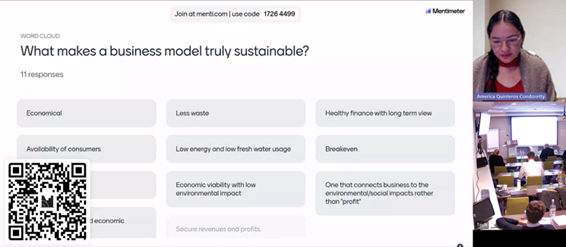
The ReLiEF presentation continued with an overview of all the leaching technologies developed within the project’s framework, including: water leaching, deep eutectic solvents (DES), pressurised leaching, microwave and acid-based leachings. The Life Cycle Assessment (LCA) of these technologies focused on various environmental impact categories, portraying the environmental, costs and social impacts for each process. The results of the LCA analysis incentivised the researchers from ReLiEF to propose the multi-industry business model as a sustainable approach, balancing socio, economic and environmental aspects of the battery value chain. In practice, the multi-industry model works by integrating the efforts of various industries to create a cohesive and sustainable approach to lithium recovery. Looking at the results of the leaching processes applied to mining waste/tailings and alloy dusts, the conclusions show that energy consumption remains the major element having an impact on the final results.
Download the PDF version of this article using this link.
Mark your calendars for 12 December 2024, when the third edition of the annual workshop of the Cluster Hub “Production of raw materials for batteries from European resources”.
The event will be hybrid. It will take place in Brussels, at Thon Hotel EU, Rue de la Loi 75, 1040. The number of seats is limited, and will be assigned on a first come first served policy. However, interested participants can attend online, upon registration with the LINK.
Batteries have been around for centuries, with successive technological advancements leading to major electrical leaps: from the early rise of telegraphs and telephones to the modern life ‘commodities’ such as consumer electronics, electric vehicles and healthcare.
Despite a policy context incentivising European stakeholders to build a climate-neutral society, this ambitious plan hinges on the electrification of two key industrial sectors – transport and energy – accounting together for 76 % of the EU’s GHG emissions. To meet the rising demand of batteries, Europe is looking for alternatives to reduce its dependency on battery imports and enhance its competitiveness in the global battery market. This push to re-industrialise Europe’s battery manufacturing is supported by technological advancements.
The Cluster Hub ‘Production of raw materials for batteries from European resources’ is organising the third edition of its annual workshop on 12 December 2024. With each edition, the hub plans to provide a comprehensive overview of the most promising technologies engaged in the production of raw materials for batteries, from raw materials mining to recycling.
Additional to the technical sessions which will present the most recent results from the member projects included in the EU-funded hub, the workshop will set off with an incursion across the European policy environment, introduced by representatives of the European Commission and BEPA.
Who is the event dedicated to?
Any stakeholder interested in the R&I context in the battery sector, whether a representative of industry, cross-sector activities, research community or a policy-maker, is welcome to participate. Each session presenting results will be concluded with a dedicated Q&A slot, where participating attendees are invited to address questions.
Beyond presenting the latest results accomplished by our member projects, the event plans to open the stage to challenging discussions, ultimately aiming to identify opportunities for value creation within the European battery sector.
Disclaimer
The event will be recorded (audio & video) and pictures will be taken. Should participants have any objections, these should be addressed to the organisers.
Registration
The event is hybrid. On site participation is limited to the conference room capacity. Seats are limited and allocated to the first 40 participants expressing interest.
Register for on site participation
The event can also be attended online, using Teams platform. Registration is mandatory.
Register here for online participation
On Thursday, 16 November, during the 2023 edition of the Raw Materials Week, the twelve EU funded projects that constitute the Cluster Hub ‘Materials for batteries’ gathered for their annual event in Brussels.
The Cluster Hub has been initiated last year during the 7th edition of the Raw Materials Week. The main objective of the meeting was to meet and discuss the latest developments in the participating projects as well as the new challenges and opportunities discovered through the projects’ lifetime. Nader Akil, Operations Manager at PNO Innovation, inaugurated this second edition outlining the motivation behind the hub’s establishment. He underlined the positive reception and sustained interest from various stakeholders keen on joining this initiative.
Discover and/or rediscover the first edition of the Cluster Hub workshop
Co-organised by RELiEF, EXCEED, ENICON and RAWMINA, the event was also the opportunity to welcome the four new members of the Cluster (EXCEED, RAWMINA, METALLICO and CRM-geothermal). the workshop gathered nearly 100 organisations driving the production and the recycling of raw materials for battery applications from primary and secondary resources.
Building on the initial objective of creating an environment that could foster knowledge exchange on different approaches for the recycling and recovery for battery applications, the event focused on three major topics that depict the transversality characterising the projects: the raw materials through research and science, the roles and challenges of industry and market for raw materials, and the raw materials under the scope of sustainability, durability and social acceptance. During this annual meeting, an interactive session led by Anish Patil from TechConcepts and representing the RELiEF project had the objective of Mapping the European battery material recycling landscape – more details to be found below, in the section referring to the interactive session.
Research and science unlocking new opportunities in raw materials
The first session was moderated by Sonia Matencio from LEITAT, representing the RAWMINA project. This session had the objective of discussing the raw materials through research and science, under the scopes of mining, refining, processing as well as the battery data. Sonia introduced this topic under the scope of RAWMINA, explaining the integrated innovative pilot system for Critical Raw Materials recovery from mine waste in a circular economy context. To this end, Christophe Aucher, from LEITAT as well, highlighted the need on an open battery passport system to better reflect and account for any adaptations that might be required due to the changing regulatory landscape.
Sonia welcomed afterward Brecht Dewulf from KU LEUVEN and representing ENICON, who discussed the sustainable processing of Europe’s low grade sulphidic and lateritic Ni/Co ores and tailings into battery grade metals. The idea behind this was to show all the potential of Ni/Co resources for Europe.
Xochitl Dominguez from VITO concentrated her speech on gas-diffusion electrocrytallisation (GDEx), a crucial topic for the projects LiCORNE and RHINOCEROS she works with. GDEx is an electrochemical process of reactive precipitation of metals in solution with oxidising or reducing agents produced in-situ by the electrochemical reduction of a gas, in a gas-diffusion electrode. This was followed by Katrin Kieling from GFZ Potsdam, working there for the CRM-geothermal project and shortly explained the challenges of extracting critical raw materials from geothermal fluids. To conclude this first session, Sandra Pavón from Fraunhofer IKTS explained the demonstration of battery metals recovery from primary and secondary resources through a sustainable processing methodology in the METALLICO project.
Discover presentations from Session 1
Insights from stakeholder perspectives: Interactive session on key EU Policies and priorities
The annual meeting followed its course with an interactive session led by Anish Patil, which scrutinised stakeholders’ perspectives on the Green Deal Industrial Plan, Net Zero Industrial Act, Critical Raw Materials Act and the European Battery Regulation 2023. Mentimeter facilitated this interactive session, engaging the audience to explore how these policies intersect, complement each other, and identify critical measures and incentives for achieving their objectives.
Over 30 persons participated in the live-poll proposed, which results display the priority to be set on funding and state aid regarding ranking the four pillars of the Green Deal Industrial Plan in order of relevance (followed by skills development, conductive regulation, and open and fair trade). Another major topic regarding the stimulation of investment in net Zero technologies, the majority of answers placed the ‘enhanced skills’ as first priority, shortly followed by facilitating the access to the market.
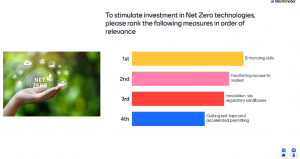
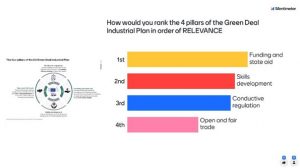
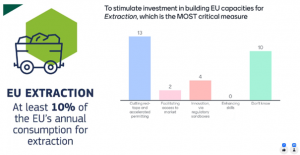
Lastly, the participants were divided regarding the critical measures to implement in the EU to stimulate investment in building domestic capacities for extraction of critical raw materials (CRMs). Although the majority opted for ‘cutting red-tape and accelerated permitting’, approximately half of the answers evoked uncertainty, which emphasised one more time the need to engage with policy makers as external stakeholders in all projects.
Navigating the nexus: industry challenges, market dynamics, social acceptance and sustainability
This interactive workshop was followed by two sessions, which aimed at discussing the challenges and opportunities of raw materials within the frame of industry and market, as well as the social acceptance, sustainability, and durability.
Alan Gonzalez from PNO Innovation Begium, representing LiCORNE, moderated the industry part, whereas Sam Hoefman from RELiEF moderated the last session on social acceptance, sustainability, and durability. Distinguished panellists took the stage to engage in debates on various topics.
Edvarts Emerson, Production and Testing Engineer at Watt4Ever, presented his work on the benchmark depository of 2nd life use of lithium in batteries, acceptance criteria and guidelines, work developed within the RHINOCEROS project. Benjamin Wilson, representing the RESPECT Project, displayed Aalto University’s work advancing efficient, sustainable, innovative and safe battery recycling processes in the EU. Laura Kainiemi from LUT University, representing the RELiEF Project, Konstantinos Komnitsas from the Technical University of Crete (TUC), on behalf of EXCEED, and Vitor Correia from INTRAW for the CRM-geothermal project, collectively debated the role and impact of social acceptance among affected communities, the importance of triggering new dialogues on responsible mining activities, and the joint involvement of regional, national and European authorities, academia, industry partners, and citizens in shaping these initiatives.
A big thank you to all participants for this co-creative and very constructive and inspiring meeting.
Discover presentations from Session 2
Discover presentations from Session 3
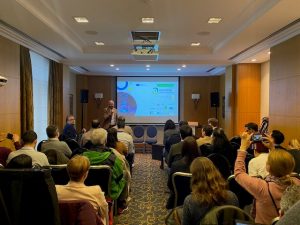
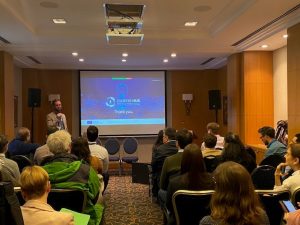
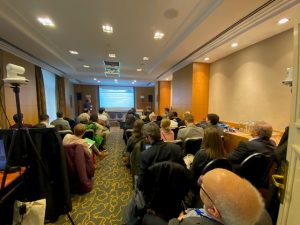
Snapshots from the second edition of the Cluster Hub workshop “Production of raw materials for batteries from European resources”
The RESPECT project is already in its first year of development, and to celebrate this important corner stone, they organise a launch event. It is time to introduce the project and discover how the RESPECT project is going to drive a positive change and accelerate the transition towards a cleaner, more sustainable world.
The event will take place online on the 5th of October from 09:00 to 12:25 CEST.
In the framework of the launch event, Batteries European Partnership Association (BEPA) is going to provide a workshop: „Sharing the best practices and common expertise to improve EU-funded R&I projects efficiency and dissemination results“. Including 2 fruitful Panel Discussions:
- „Lessons learned from other clusters“ (Collabat, Solid4B (waiting for confirmation) and Battery heroes)
- “Clustering activities for the projects on Sustainable, safe and efficient recycling processes?” (RESPECT, FREE4LIB, RHINOCEROS (waiting for confirmation))
The 3 Panel discussion “How do R&D projects support the creation of the EU battery value chain and the implementation of the new legislative requirements?” will cover several aspects related to the implementation of Battery Regulation.
Project description:
RESPECT project proposes a logistical chain of disruptive, flexible, sustainable and versatile recycling processes that consider the safety aspects of battery opening and deactivation, and utilizes hydrometallurgy or direct recycling, depending on the targeted LIBs to be treated, thereby supporting the next generation of battery materials development.
The vision of the RESPECT project is to contribute to paving the way for increasing global competitiveness, strategic autonomy and circularity of the European battery ecosystem by developing innovative green recycling materials recovery processes, and thus supporting the growing Li-ion battery manufacturing in Europe.
On Monday, 10 July 2023, the Council of the European Union adopted a new regulation that strengthens sustainability rules for batteries and waste batteries. This regulation covers the entire life cycle of batteries, ensuring their safety, sustainability and competitiveness from production to reuse and recycling.
Read the official press release
Recognising the vital role batteries play in the decarbonisation process and the transition towards zero-emission mobility, Teresa Ribera, Spanish Minister for the Ecological Transition reinforced the Presidency’s support for the regulation, which applies to all types of batteries: waste portable batteries, electric vehicle batteries, industrial batteries, starting, lightning and ignition (SLI) batteries primarily used in vehicles and machinery, as well as batteries for light means of transport like electric bikes, e-mopeds, and e-scooters.
“At the same time end-of-life batteries contain many valuable resources and we must be able to reuse those critical raw materials instead of relying on third countries for supplies. The new rules will promote the competitiveness of European industry and ensure new batteries are sustainable and contribute to the green transition.”
| Teresa Ribera, Spanish Minister for the Ecological Transition
To foster a circular economy, the regulation establishes requirements for the end-of-life phase, including collection targets and obligations, material recovery targets, and extended producer responsibility. Dedicated collection objectives for waste batteries used in light means of transport will be implemented, aiming at 51% by the end of 2028, respectively 61% by the end of 2031. Furthermore, the regulation sets mandatory minimum levels of recycled content for industrial batteries, SLI batteries and electric vehicle batteries. The following initial values have been established:
- 16% for cobalt
- 85% for lead
- 6% for lithium
- 6% for nickel
Additionally, batteries will also be required to hold documentation proving their recycled content.
To improve the functioning of the internal market for batteries and ensure fair competition, the regulation introduces safety, sustainability, and labelling requirements. It includes provisions for battery labelling and information disclosure, including details on battery components and recycled content. Additionally, an electronic “battery passport” and a QR code will be implemented to enhance traceability and transparency. These labelling requirements will take effect by 2026, while the QR code implementation is expected by 2027, providing member states and manufacturers with ample time to prepare.
This new regulation aims to mitigate environmental and social impacts throughout the battery’s life cycle. By establishing strict due diligence rules for operators, the EU is ensuring operators are bound to verify the source of raw materials used for batteries placed on the market. However, the regulation provides for an exemption for SMEs from the due diligence rules.
The adoption procedure for the regulation concluded with the Council’s vote, and it will now proceed to be signed by both the Council and the European Parliament. Following this, the regulation will be published in the European Union’s Official Journal and will enter into force 20 days thereafter.
Monitoring Crucial Secondary Legislation Linked to the Batteries Regulation
The new regulation aiming at strengthening sustainability rules for batteries and waste batteries will be supported by various secondary legislation pieces that play a crucial role in ensuring the comprehensive and effective implementation of the proposal’s objectives, particularly in important areas such as raw material sourcing, battery design, manufacturing processes, the second-life of a battery, and battery recycling and reuse.
One of the most urgent legislations is the carbon footprint (Art. 7) methodology for electric vehicles (EVs), which is under development with the JRC report and is expected by early 2024. Another relevant piece of secondary legislation is referring to recycling efficiencies (Art. 71), where the JRC is closely working with stakeholders in different expert groups.
The Cluster Hub “Production of raw materials for batteries from European resources” within the current legislative framework
As the implementation of the new battery regulation progresses, the Cluster Hub will continue to serve as a catalyst for advancements in battery recycling. By leveraging the collective efforts and expertise of participating projects, the platform acknowledges its pivotal role in driving the transition towards a more sustainable and circular future for the battery industry in Europe.
Get to know the EU-funded projects driving the innovations for the recycling of batteries: CROCODILE, RHINOCEROS, BATRAW, FREE4LIB, RESPECT, RELiEF and LiCORNE.

 Website managed by PNO Innovation